
Beyond the Report Card: A Child Is More Than a Number
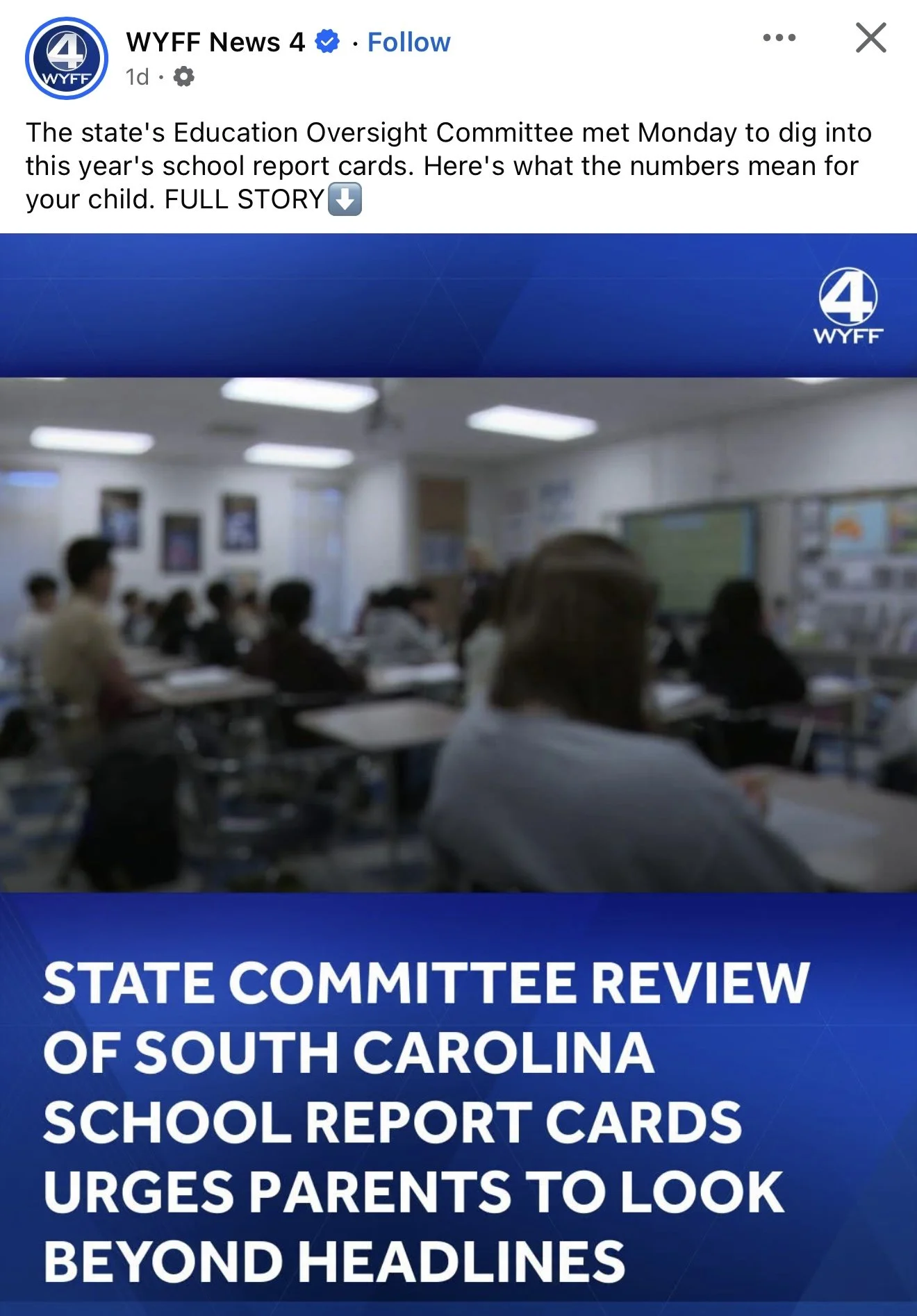
Reflecting on Dr. Kelley's statement earlier this week that “a ZIP code should not define a student's success” has stayed with me as I reviewed WYFF News 4's latest report on South Carolina's school report cards.
The report reminds us that even when a school earns an Excellent rating, it doesn't necessarily mean every student is performing at grade level. We should celebrate our schools' accomplishments. Absolutely! But we should also be willing to look beyond the overall ratings and ask some important questions.
Are our children learning at grade level? Are they making progress? Do our teachers have the support they need? Are we preparing students for what comes next; the next grade level, college, careers and life?
And what about the challenges that follow children into the classroom every morning that schools and teachers have little or no control over?
For more than a decade, through my work with AnMed Foundation's funding of Access Health initiatives and The Duke Endowment's Healthy People, Healthy Carolinas initiative—Live Healthy Anderson County—I've seen firsthand how closely health, education and opportunity are connected.
Transportation. Food insecurity. Access to healthcare. Unstable housing. Family circumstances.
These aren't simply healthcare challenges or school challenges. They're community challenges.
In our work to improve community health, we've learned that no single organization can solve these problems alone. It takes people and organizations willing to come together, share resources, take responsibility and work toward a common purpose.
I believe the same principle applies to education.
Standing in the Gap
To me, serving as a School Board Trustee means more than sitting at the board table. It means standing in the gap when our students face challenges that schools cannot solve alone.
A child who is hungry, experiencing unstable housing, lacking positive adult support and encouragement, or unable to access healthcare faces barriers to learning that extend well beyond the classroom. We already have healthcare providers, nonprofits, faith communities, mentoring programs, businesses and public agencies working to address many of these challenges.
We don't necessarily need to create something new. We need to connect the work already being done.
That's where I believe trustees can make a difference.
My commitment is to help convene those relationships, connect existing community resources with ASD5's strategic goals, and identify opportunities where working together creates mutual value and measurable outcomes. Through my work with Access Health and Live Healthy Anderson County, I've learned that successful partnerships begin with shared priorities, clear responsibilities and a willingness to work across organizational boundaries.
The School Board's responsibility is to govern, establish strategic priorities and hold the district accountable, while respecting the Superintendent's role in leading its day-to-day operations. Working collaboratively with the Superintendent, trustees can also leverage their relationships, experience and community networks to help connect existing resources with the district's strategic goals and the needs of our students.
When our schools identify a gap, I want to help bring the people and organizations capable of addressing it to the table. Our teachers and administrators have an enormous responsibility. So do parents, healthcare providers, nonprofits, businesses, churches and community leaders.
That doesn't mean lowering academic expectations. Quite the opposite. It means recognizing what it may take to help more children meet them.
I keep coming back to Governor McMaster's three C's: Communicate. Collaborate. Cooperate.
Every Child Matters!
Putting Kids First
School report cards are important. They help us understand performance, measure progress and identify where improvement is needed. But they don't tell us everything about the children behind those numbers.
Anderson Five serves approximately 11,600 students across 22 campuses, with families speaking nearly 30 languages. Each child has a different story, different strengths and different needs.
A child's ZIP code should not determine their opportunity to succeed.
Helping every child reach their full potential will take more than our schools alone. It will take a community willing to work together, align its resources and share responsibility for meaningful results.
Putting Kids First means every single one of them.
